
SAT PREP, COLLEGE ADMISSION, SURVIVE AND THRIVE IN COLLEGE, UNIVERSITY, AND IN LIFE
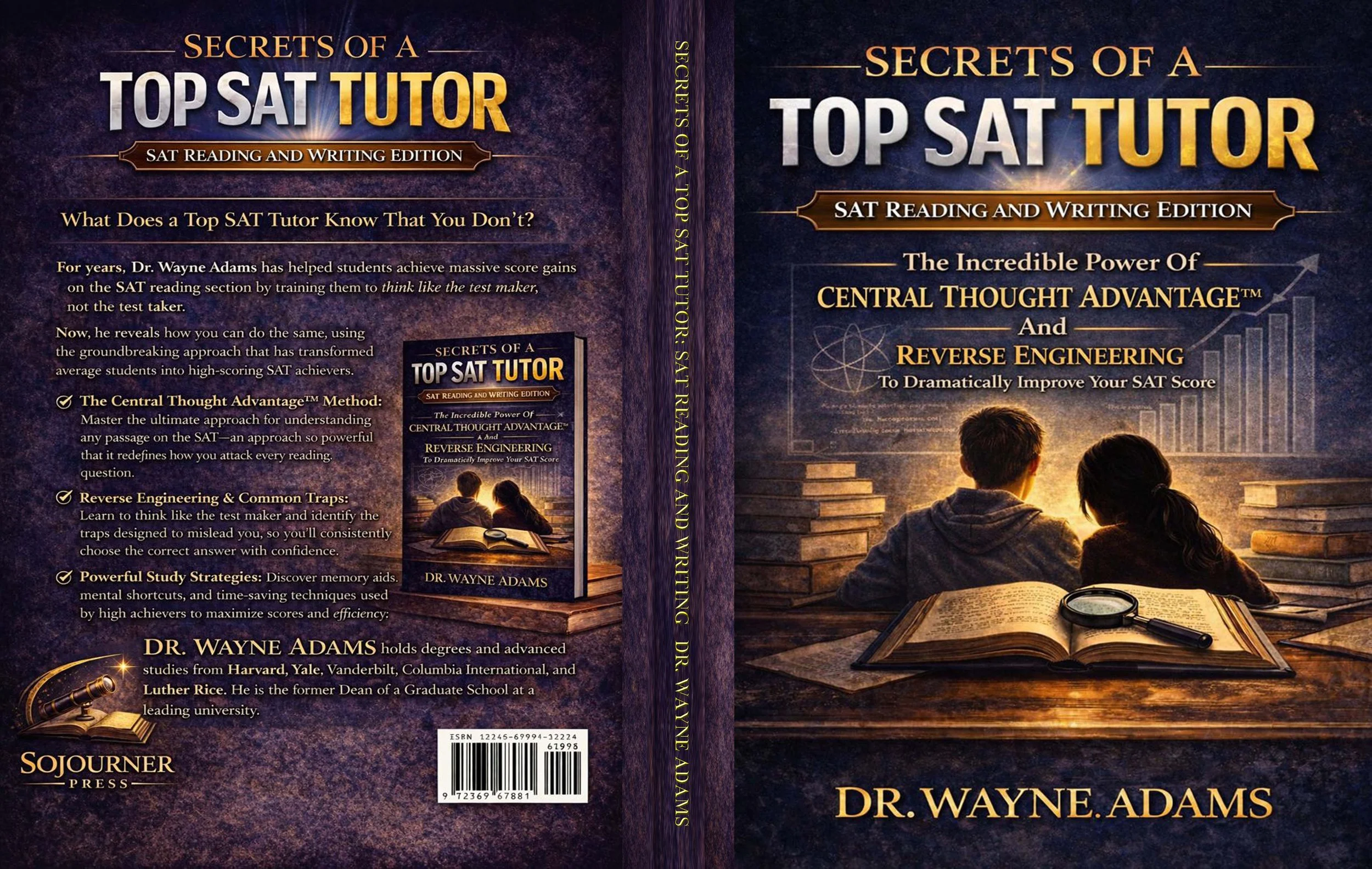
Secrets of a Top SAT Tutor – Reading and Writing Edition reveals why most students prepare for the SAT inefficiently—and how a small shift in thinking can produce dramatic score gains.
The SAT does not reward speed reading, memorization, or guessing. It rewards precision, pattern recognition, and disciplined reasoning.
Yet many students approach Reading and Writing as if it were an English class rather than a logic-driven assessment.
This book changes that mindset.
Drawing on years of high-level SAT instruction and real score improvement, Dr. Wayne Adams introduces two powerful frameworks: Central Thought Advantage™ and Reverse Engineering. Together, these methods teach students how the test is built, how questions are designed, and how correct answers are constructed—before looking at answer choices. Rather than focusing on isolated strategies, this guide trains students to identify the controlling idea of every passage, sentence, and question.
Central Thought Advantage™ anchors comprehension, eliminates distraction, and prevents common traps caused by over-reading or emotional interpretation.
Reverse Engineering then teaches students to work backward from the question, predicting correct answers and recognizing why wrong choices are written to deceive.
The book systematically addresses the core Reading and Writing skills tested on the Digital SAT, including central ideas, command of evidence, logical transitions, rhetoric, grammar, and style.
Students learn how to spot patterns, manage time, and maintain accuracy under pressure—even with unfamiliar topics.
What sets this guide apart is its emphasis on thinking, not tricks. Practice becomes intentional. Errors become diagnostic. Confidence grows as students understand the test rather than fear it.
Written for students, parents, tutors, and educators, Secrets of a Top SAT Tutor – Reading and Writing is both a strategic playbook and a mindset shift. It empowers students to take control of the exam, reduce anxiety, and unlock performance they may not realize they already possess.
This is not about working harder—it is about thinking smarter, reading with purpose, and answering with certainty.
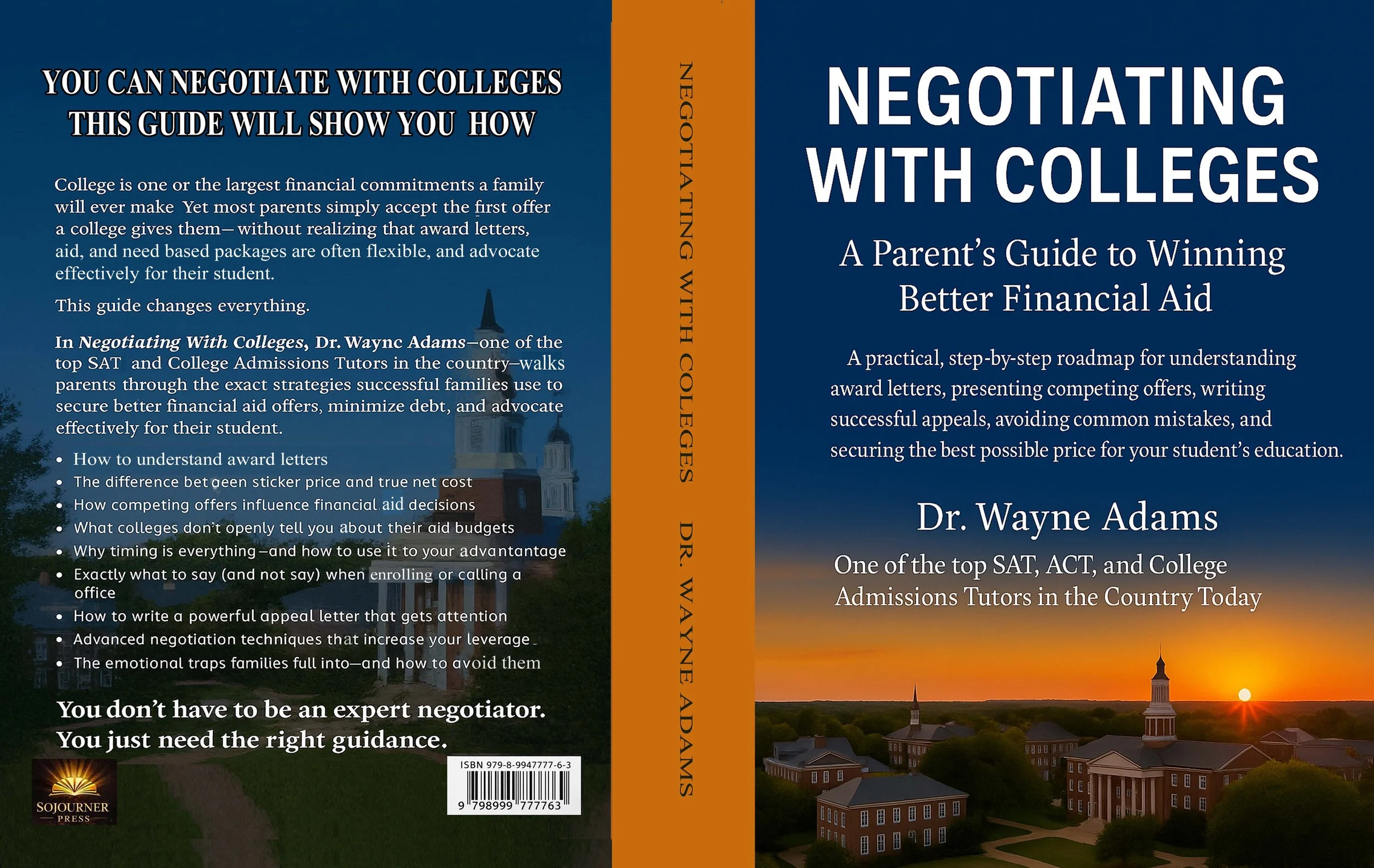
College is one of the largest financial commitments most families will ever make.
Yet most parents are not aware that they can effectively negotiate with colleges and universities!
Negotiating With Colleges and Universities equips families with the knowledge, confidence, and practical strategies needed to navigate the complex realities of college pricing and financial aid negotiations and negotiate the best deals for their students.
Written by Dr. Wayne Adams, an experienced educator,college admissions advisor, corporate negotiator … this guide explains how colleges actually determine tuition pricing, allocate financial aid, and evaluate appeals.
Parents learn why the published sticker price is rarely the true cost of attendance, how merit aid and need-based aid differ, and how institutional priorities influence award decisions.
Rather than relying on myths or assumptions, families are taught how to approach negotiations with clarity, preparation, and professionalism.
The book provides a step-by-step framework for understanding financial aid award letters, identifying leverage, and communicating effectively with admissions and financial aid offices.
Readers learn when and how to appeal, what documentation strengthens a case, how competing offers can influence outcomes, and what language builds cooperation rather than resistance. Practical guidance is offered for both written appeals and in-person or phone conversations, helping families advocate effectively without confrontation.
Real-world case examples throughout the guide illustrate the tangible financial impact of informed negotiation. One featured case describes a family who successfully reduced their college costs by $40,000 per year at a highly selective university through a well-prepared and respectful appeal.
Many families have reduced costs between $5,000 and $50,000 per year in tuition, fees, room, board, and related expenses—depending on the cost structure, policies, and competitiveness of a specific college or university. This book emphasizes that negotiating with colleges is not about pressure or manipulation.
It is about stewardship, preparation, and informed decision-making.
Parents are guided to protect long-term financial stability, minimize unnecessary student debt, and make enrollment decisions based on clarity rather than urgency. Designed for parents of college-bound students at any stage of the admissions process.
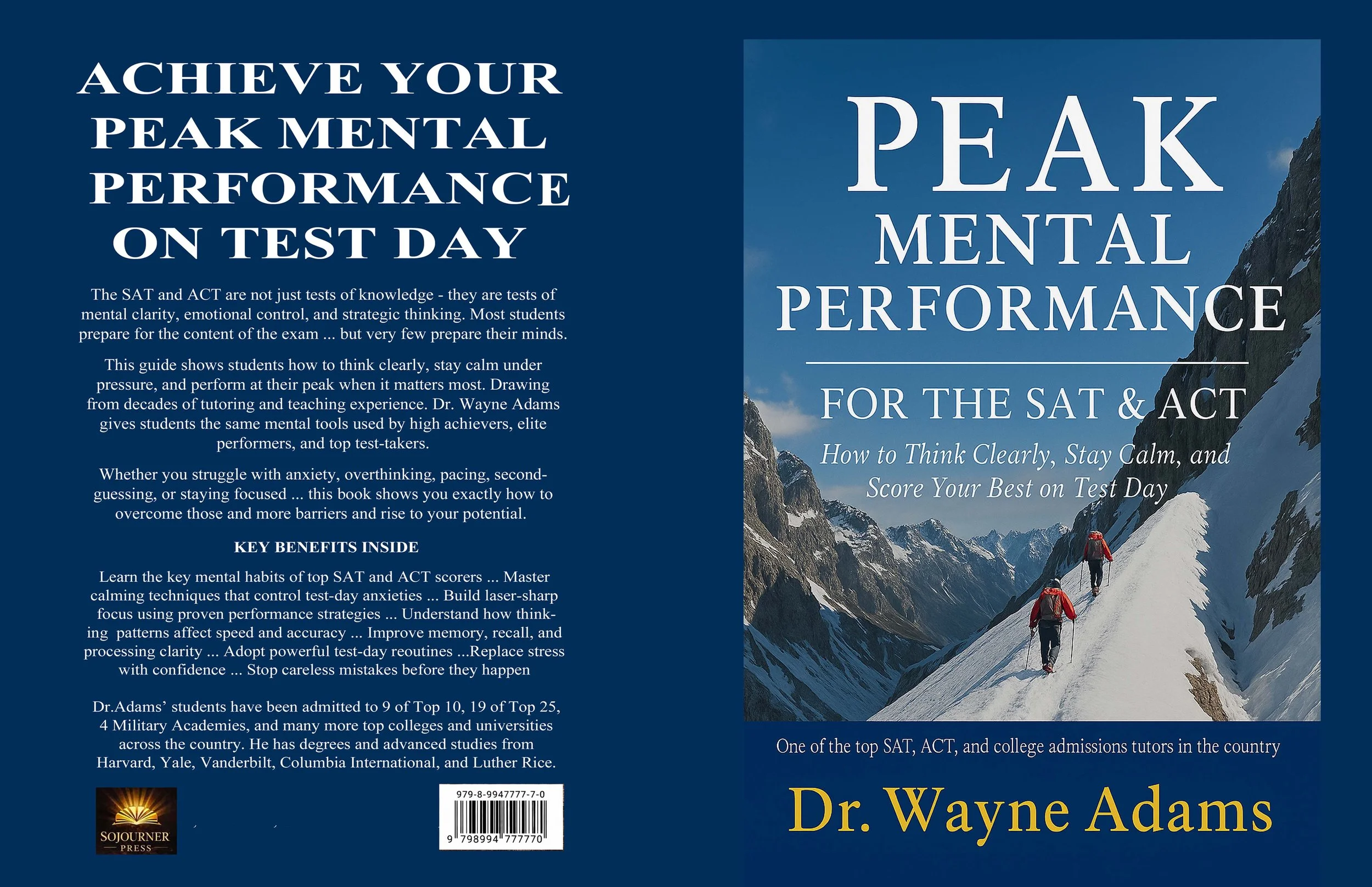
Standardized tests such as the SAT and ACT are not only academic assessments—they are psychological events.
While most test preparation focuses on content mastery, many capable students underperform because anxiety, pressure, and mental overload interfere with clear thinking.
Dr. Adams strongly believes half of students doing their best on these tests is mental.
Peak Mental Performance for the SAT & ACT addresses this overlooked dimension of test success by teaching students how to manage their mental state before and during high-stakes exams.
Drawing on more than five decades of experience in education, tutoring, and high-performance coaching, he presents a practical, research-informed framework for improving test performance through mental regulation.
The book introduces the concept of the Peak Performance Zone (PPZ)—a cognitive state in which calm focus, steady pacing, and emotional balance allow students to access their knowledge efficiently under timed conditions.
Through clearly structured chapters, students learn how anxiety affects cognition, how stress can either enhance or impair performance, and how to recognize early warning signs of mental spirals.
The guide provides actionable techniques—including breathing control, visualization, self-talk, thought-stoppers, physical resets, gratitude, and perspective shifts—that can be applied discreetly during the exam to restore clarity and prevent panic.
The book also helps students identify their individual “test personality,” enabling them to customize strategies based on how they naturally think and respond under pressure.
Rather than promising shortcuts or score guarantees, Peak Mental Performance for the SAT & ACT emphasizes resilience, recovery from mistakes, and consistent execution—skills that often separate strong performers from those who stall despite solid preparation.
Designed for students, parents, tutors, and educators, this guide complements traditional academic test prep by addressing the mental skills required for peak performance.
Beyond standardized testing, the principles taught in this book translate to broader academic challenges and life situations that demand composure, focus, and confidence under pressure.
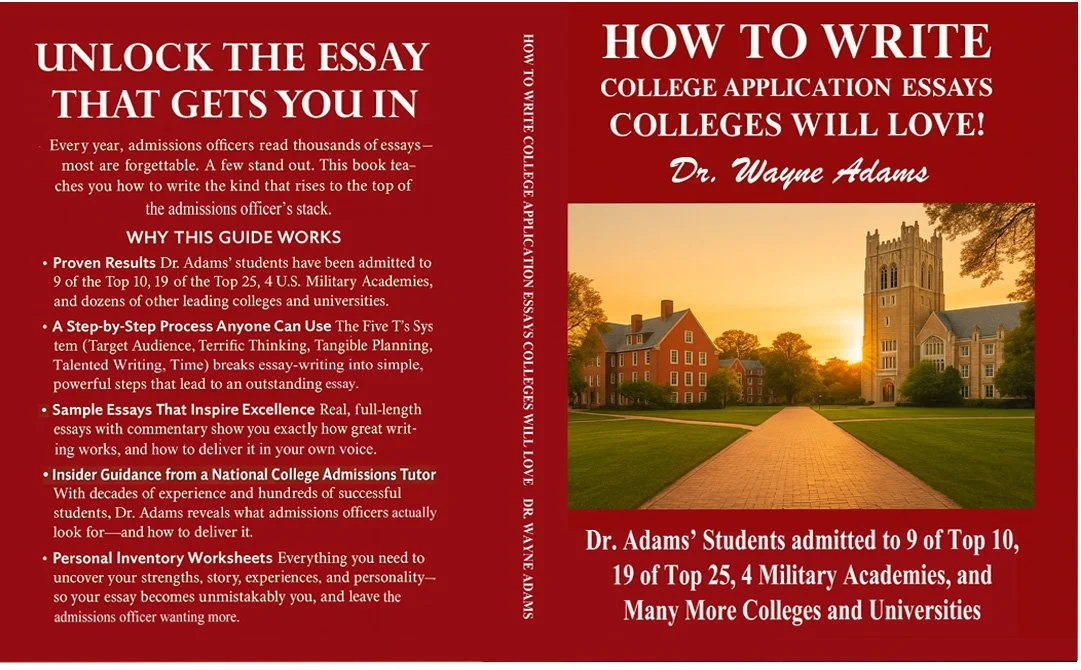
How to Write College Application Essays Colleges Will Love is a practical, no-nonsense guide that shows students exactly how admissions officers actually read — and judge — application essays.
Instead of vague advice and recycled clichés, this book walks students step-by-step through a proven system used to create memorable, authentic, and competitive essays.
You will learn how to think like an admissions reader, uncover meaningful personal stories, and structure essays that stand out in under sixty seconds — the time many applications actually receive. Inside, you’ll discover:
• The “Hook–Look–Took” structure that makes essays unforgettable
• The Five T’s of outstanding college writing
• How to develop real ideas before writing a single sentence
• A complete personal inventory system to generate powerful topics
• What colleges are now using to detect AI-written essays • Why AI-generated essays can hurt — and how to use AI ethically
• Fully annotated real sample essays with professional evaluations
• How to turn talents, struggles, and experiences into compelling narratives
• Techniques for selective universities and scholarship competitions Unlike typical essay books, this guide doesn’t just tell you what works — it shows you why it works and how to replicate it with your own authentic voice.
If you want an essay that sounds like you, feels real, and actually gets remembered by admissions readers, this book provides the blueprint. Your story matters. Learn how to tell it so colleges listen.
This book was developed to help students present their authentic stories in a clear, memorable, and meaningful way during the college admissions process.
The essays included throughout this book were created in collaboration with real students for instructional purposes.
The evaluations, commentary, and instructional framework were written to demonstrate principles of effective storytelling, reflection, and communication — not to provide a formula for imitation. Readers are encouraged to learn from structure and technique while expressing their own genuine voice.
This book is an educational resource. It is not affiliated with, endorsed by, or approved by any college, university, testing organization, or admissions office. Admissions decisions vary widely by institution and applicant, and no outcome can be guaranteed. Artificial intelligence tools may be used ethically for brainstorming, editing, and learning; however, students are responsible for ensuring that submitted work reflects their own thinking and authorship.
The goal of this book is simple: to help students understand themselves better — and communicate that understanding honestly.
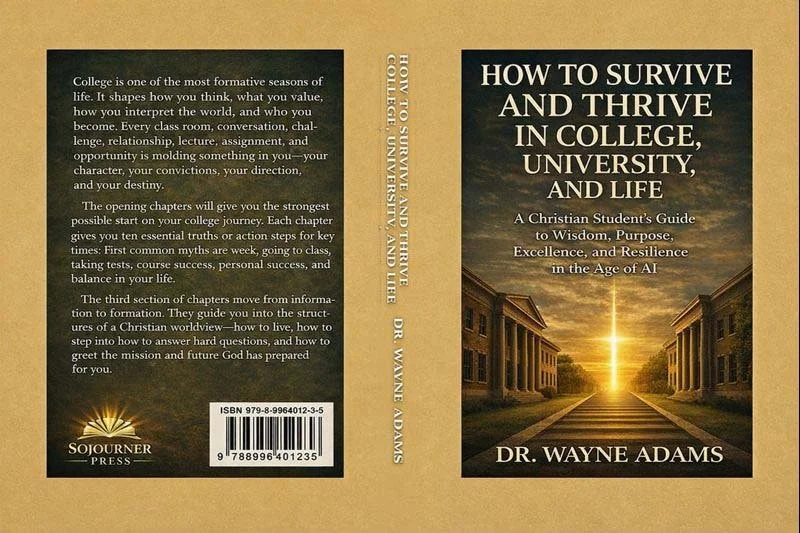
College and university years now unfold in a world unlike any previous generation has known.
Artificial intelligence reshapes learning, careers evolve at unprecedented speed, truth feels contested, and pressure to perform has never been higher.
In this environment, success requires more than intelligence or adaptability—it requires wisdom, grounding, and spiritual resilience.
How to Survive and Thrive in College, University, and Life is written to equip Christian students to navigate this new landscape with clarity, courage, and conviction.
It addresses not only how to succeed academically, but how to form a life of purpose and integrity in an age of constant change, digital saturation, and competing worldviews. Drawing from Scripture, leadership experience, and decades of mentoring students and professionals, Dr.
Dr. Adams provides a framework for wise decision-making, disciplined thinking, and faith-centered excellence.
The book explores the real challenges students face today: academic pressure, ethical shortcuts, identity confusion, anxiety, comparison, loneliness, and the temptation to outsource thinking and responsibility to technology.
Rather than rejecting innovation, this guide helps students understand how to engage tools like AI without surrendering discernment, creativity, or moral responsibility.
It emphasizes that while technology can accelerate productivity, it cannot replace character, calling, or spiritual formation.
Throughout the book, adversity is reframed as preparation. Academic setbacks, relational strain, uncertainty about the future, and spiritual doubts are not signs of failure, but training grounds for endurance and maturity.
True thriving is defined not by grades, accolades, or speed, but by wisdom under pressure, excellence with integrity, and resilience anchored in faith.
Written for Christian students, parents, educators, campus ministries, and faith-based institutions, How to Survive and Thrive in College, University, and Life is both a practical guide and a spiritual compass.
It prepares students not only to graduate—but to lead, discern, and live faithfully in a world shaped by AI, sustained by wisdom, and guided by God.
Thoughtfully crafted to elevate what matters most.
Thoughtfully crafted to elevate what matters most.