
Business and Leadership
BOOKS AVAILABLE
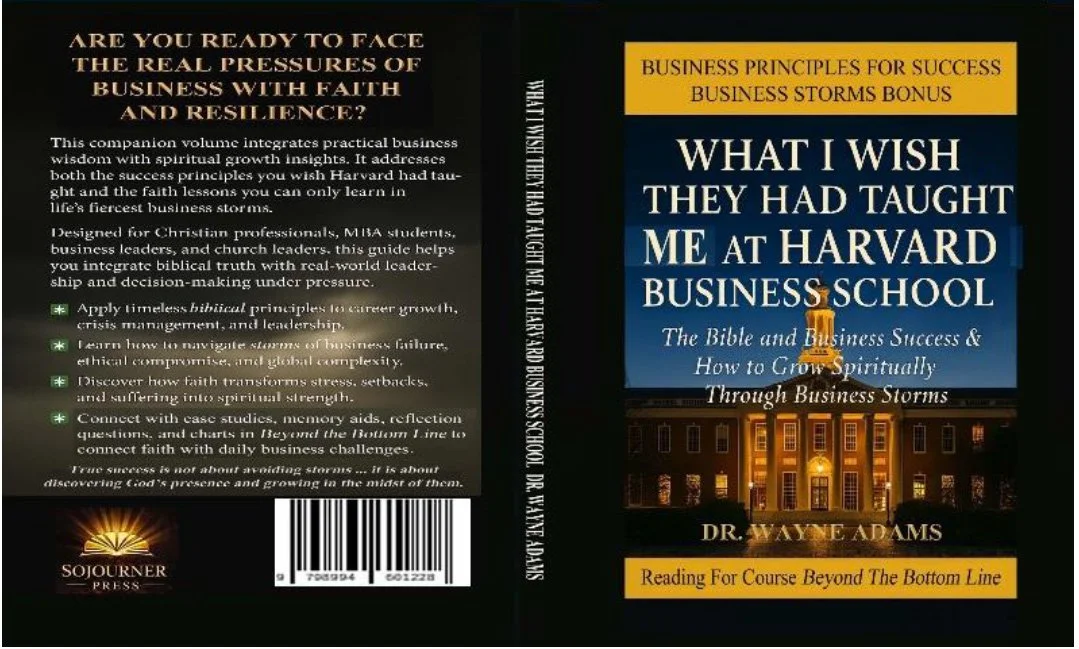
What I Wish They Had Taught Me at Harvard Business School is not a critique of elite business education—it is a completion of it. Harvard Business School taught frameworks, strategy, analytics, leadership, and decision-making under pressure.
Those tools are powerful and essential. But there were critical lessons left unspoken—lessons about the soul of leadership, the hidden cost of success, and how to grow spiritually when business storms inevitably come.
This book explores the intersection of faith, ambition, adversity, and calling. Drawing on real-world experience across consulting, executive
leadership, entrepreneurship, government service, academia, and professional selling, Dr. Wayne Adams invites readers behind the scenes of high-pressure business life to examine what truly sustains leaders when markets collapse, careers pivot, reputations are tested, and outcomes are uncertain.
Rather than promoting escape from ambition, this book seeks to redeem it. It addresses questions every serious leader eventually faces:
· What happens when success accelerates faster than character?
· How do we make ethical decisions when the cost of obedience is high?
· What does it mean to trust God when data, forecasts, and control fail?
· How can business storms become instruments of spiritual formation rather than sources of burnout or compromise?
Blending biblical wisdom with modern leadership realities, this book shows how trials refine judgment, clarify priorities, and deepen dependence on God. Business storms—unexpected losses, setbacks, conflicts, and failures—are reframed not as detours, but as classrooms where faith is strengthened, integrity is tested, and true leadership is forged.
Written for executives, entrepreneurs, MBA students, emerging leaders, and anyone navigating high-stakes professional life, What I Wish They Had Taught Me at Harvard Business School offers practical insight, spiritual depth, and a compelling vision for success that endures beyond titles, balance sheets, and accolades.
This is a guide for those who want to rise—without losing their way—and to grow spiritually while leading courageously through the storms that shape a life well lived.

So You Want To Be A Billionaire?
Across the modern marketplace, Christians encounter a constant stream of ideas about success, wealth, influence, and leadership.
Many of these ideas contain insight. Some contain assumptions.
Few are examined carefully in the light of Scripture.
The purpose of this volume is not to reject business learning, but to interpret it — to place contemporary thinking about extraordinary achievement beside biblical wisdom and allow the reader to discern the difference.
This work is part of the Book Reviews for Christians in Business series.
Rather than merely summarizing popular business concepts, the series asks a deeper question: not only what works, but what lasts. The marketplace rewards effectiveness; Scripture addresses allegiance. When these align, work becomes stewardship. When they separate, success can quietly become substitution.
This book therefore studies wealth through the life of Solomon — the most prosperous and wisest leader recorded in Scripture — alongside modern discussions of extreme success.
The intent is neither criticism nor admiration alone, but clarity.
Wealth is neither inherently virtuous nor inherently corrupting. It is revealing. It magnifies the direction of the heart. Other writings in this broader body of work examine organizational dynamics, leadership responsibility, and the internal pressures experienced by those who lead.
This volume approaches the same reality from another angle: not the structure of leadership, but the meaning of success itself.
Together they explore a single concern — how believers can live and work faithfully in environments where achievement is measurable but devotion is not.
The goal is not to produce billionaires, nor to condemn ambition, but to restore proportion.
Competence matters. Diligence matters. Creativity matters.
et Scripture insists that none of these define a life’s final outcome. A person may gain influence and still lose direction, build systems and still lack peace, or achieve admiration without securing eternity.
If this book succeeds, it will not simply inform the reader about wealth. It will clarify what wealth cannot do — and what only God can.

A Woman’s Place Is Wherever God Wants You is a thoughtful Christian reflection on women, career, and calling, written as a response to modern workplace discussions about leadership and ambition.
Rather than rejecting contemporary ideas about women’s professional advancement, the author engages them carefully and filters them through a biblical worldview.
The book’s central argument is that a woman’s role is not determined by culture, stereotypes, or even traditional expectations, but by God’s personal calling.
Adams repeatedly emphasizes that there is no single “correct” path—some women may lead organizations, others may run businesses, and others may focus on family life at different seasons.
The unifying principle is obedience rather than comparison.
One of the strongest aspects of the book is its balance. Instead of portraying ambition as sinful or portraying career success as ultimate, the author reframes success as faithfulness. Professional achievement, wealth, and influence are described as tools God may use, not identity markers.
This perspective allows readers to think about work without guilt but also without idolizing success.
The book also addresses real challenges women face in business: self-doubt, unequal expectations, family pressures, and fear of judgment within church communities.
Adams acknowledges these tensions and encourages discernment—sometimes leaning into opportunity, sometimes stepping back for spiritual or relational priorities. A particularly meaningful section explores biblical women such as Lydia, Priscilla, and Phoebe, presenting them as examples of faithful economic and leadership influence.
By highlighting their entrepreneurship, partnership, and service, the author argues that Scripture supports women’s active participation in work and leadership when guided by God’s purposes.
Overall, the book is less a rulebook and more a guide for reflection.
Its tone is pastoral and encouraging rather than argumentative.
Readers seeking rigid prescriptions may find it open-ended, but those seeking wisdom for navigating faith and career will appreciate its emphasis on calling, character, and humility.
In conclusion, A Woman’s Place Is Wherever God Wants Her invites Christian readers to redefine success as faithful obedience and to approach work as a form of stewardship.
It offers reassurance that career decisions are not spiritual liabilities when surrendered to God’s direction.
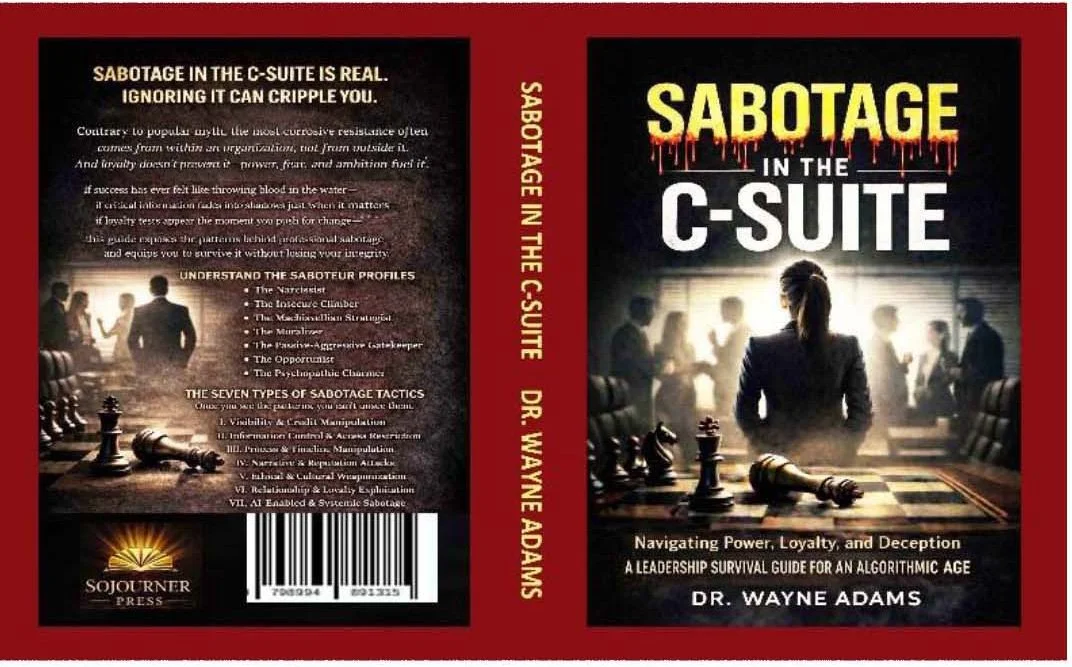
Sabotage in the C-Suite: How to Spot It, Defend Yourself, and Win in the Age of AI is a strategic leadership guide for current and future senior executives, high-potential leaders, consultants, business professors, and MBA’s who are now or may be navigating the hidden realities of power, politics, and perception at the highest levels of modern organizations in the future.
While most leadership training focuses on performance, alignment, and execution, this book addresses a quieter and more dangerous threat: invisible opposition that erodes influence without ever declaring itself.
Sabotage in the C-Suite reveals how sabotage increasingly replaces open conflict as leaders rise in authority and visibility. At senior levels, careers rarely stall because of incompetence. They stall because information is withheld, narratives are reshaped, access quietly narrows, and decisions are made elsewhere—often behind the cover of professionalism, process, or data.
The book provides a clear framework for recognizing sabotage patterns before they become irreversible.
Readers are introduced to recurring saboteur profiles—such as the Narcissist, the Insecure Climber, the Machiavellian Strategist, the Moralizer, the Passive-Aggressive Gatekeeper, the Opportunist, and the Psychopathic Charmer—not as caricatures, but as predictable responses to fear, competition, and power scarcity. Each profile is examined through observable behaviors, early warning signs, and ethical counter-strategies that preserve credibility and integrity.
It also describes the Seven Types of Attack Strategies, the 25Attack Tactics, the Process, and how to defend yourself, Examples of the same patterns from Scripture, Quick Review Grids for Key Points, throughtful Reflection Questions, and an Invitation to God’s S-Suite.
A central focus of the book is how artificial intelligence and algorithmic decision systems have amplified sabotage by creating new forms of plausible deniability. Performance dashboards, sentiment analysis, engagement scores, and automated risk signals increasingly shape leadership outcomes, allowing influence to be exercised without direct confrontation or accountability.
The book explains how leaders can audit these systems, document defensively without paranoia, and respond strategically rather than emotionally.
Rather than encouraging manipulation or cynicism, Sabotage in the C-Suite equips leaders to survive with clarity and self-respect. It emphasizes discernment over suspicion, preparation over paranoia, and ethical strength over brute force with practical tools before the damage is done.
To Dr. Adams’ knowledge, this critical lessons for survival and growth are not taught in any MBA or other college/university program, executive training seminars, or other business guides or books.

Faithful In A World That Isn’t Fair: Serpents And Doves is written as a practical companion to Sabotage in the C-Suite.
That earlier work examined leadership environments from the executive perspective — how influence, insecurity, perception, and hidden dynamics shape decision-making at the highest organizational levels. It explored why capable leaders sometimes make damaging choices, why communication breaks down despite intelligence, and how unseen pressures quietly alter judgment.
Serpents and Doves approaches the same reality from the other side of the table.
Most professionals do not sit in the executive chair, yet they work daily inside systems shaped by it.
They experience decisions without always seeing the pressures behind them. They face conflicts they did not create, expectations they do not control, and outcomes that appear disconnected from effort.
This book interprets that environment.
Rather than teaching manipulation or career strategy, it seeks to provide clarity — helping believers recognize what is happening around them so they can respond with wisdom instead of frustration, and integrity instead of withdrawal.
Through practical examples and biblical case studies — including Joseph, Daniel, David, Nehemiah, and Jesus Himself — readers discover how faithful people have always lived wisely within imperfect systems. Topics include navigating insecure leadership, communicating without escalating conflict, setting healthy boundaries, handling criticism, maintaining reputation, exercising leadership, and pursuing promotion without moral drift. This book does not encourage political maneuvering or withdrawal. Instead, it reframes influence as stewardship — the ability to help truth be heard, relationships remain healthy, and good work flourish in environments that do not naturally reward it.
Where Sabotage in the C-Suite explains why leadership environments behave as they do, Serpents and Doves explains how to live faithfully within them.
The goal of both works is the same: Not power. Not advantage. But understanding — so that character can survive where confusion often destroys it.
Together, they form a single conversation about influence, responsibility, and Christian faithfulness in complex professional systems.

How to Win Over Mammon confronts one of the most subtle and destructive forces shaping modern life—money’s power to quietly claim the human heart.
Mammon is not merely wealth. It is a spirit, a system, and a way of thinking that promises security, identity, and worth through accumulation, status, and control. In boardrooms, classrooms, startups, and homes, mammon whispers that more is never enough and that success justifies compromise.
This book exposes that lie—and offers a better way.
Drawing from Scripture, leadership experience, and real-world case studies, Dr. Wayne Adams explores how mammon operates beneath the surface of ambition, achievement, and decision-making.
Rather than demonizing work or wealth, this book reclaims them, showing how prosperity can either enslave the soul or serve God’s purposes—depending on who truly rules the heart.
How to Win Over Mammon is not about rejecting success.
It is about mastering it.
Readers are guided through the internal battles that arise when faith and finances collide: ethical pressure, fear of loss, pride, comparison, greed, and misplaced trust. These struggles often surface most intensely during business storms—economic downturns, career disruptions, financial risk, and moments when obedience to God appears costly.
Through biblical insight and practical reflection, the book reveals how financial trials become spiritual proving grounds. Mammon thrives on fear and control; faith grows through surrender, stewardship, generosity, and trust in God’s provision. When money loses its throne, clarity returns, decisions strengthen, and leadership aligns with eternal values.
Written for entrepreneurs, executives, professionals, students, and anyone navigating financial pressure in a performance-driven world, How to Win Over Mammon offers a clear framework for living free in a culture obsessed with gain.
This book challenges readers to examine not just what they earn, but what they serve. True victory over mammon is not measured by how much we possess—but by who possesses our hearts.
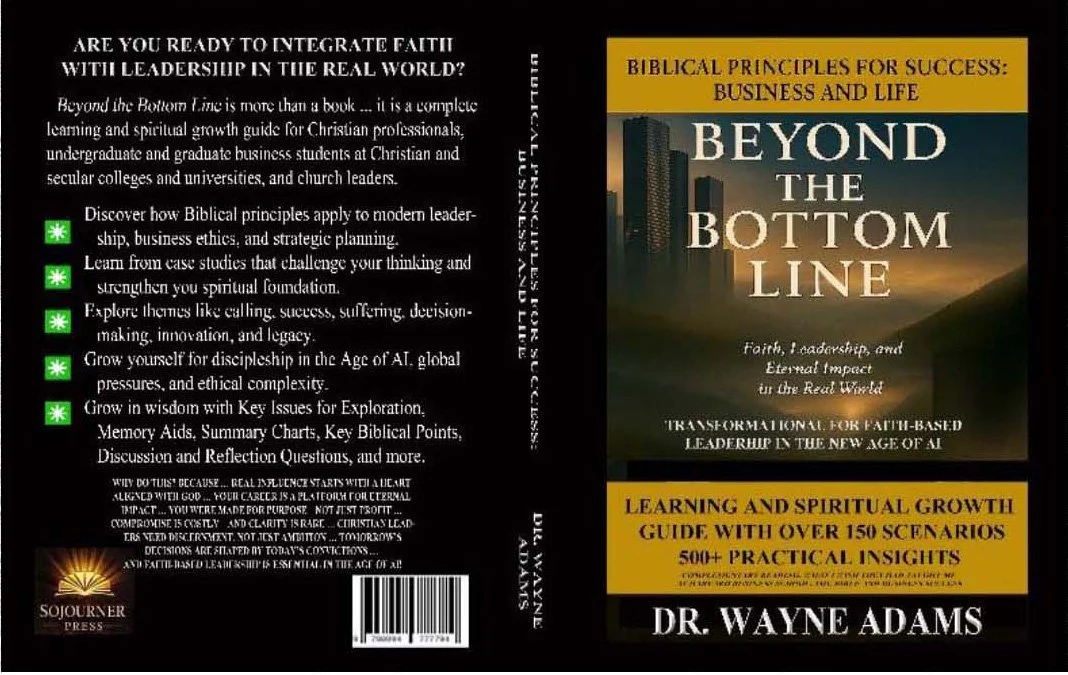
Biblical Principles for Success: Business and Life is written as a teaching and application resource that presents biblical instruction through the lens of contemporary professional life.
Rather than approaching Scripture only as historical record or devotional reading, the work examines how its principles operate within modern organizational environments, economic systems, and leadership responsibilities.
The book forms part of a broader instructional framework related to the Beyond the Bottom Line curriculum developed for colleges, universities, and leadership training programs.
Within that context, the material expands the learning experience by illustrating how biblical narratives function as practical case studies rather than abstract moral lessons.
The emphasis is not merely on what the figures of Scripture believed, but on how they made decisions while operating inside complex systems of authority, risk, scarcity, and responsibility.
Several biblical figures are examined from this applied perspective. Joseph is considered as an administrator who preserved a nation during economic crisis; Moses as a leader confronting institutional resistance; Caleb and Joshua as examples of conviction and succession leadership; Abraham as a venture pioneer acting under uncertainty; David and Solomon as organizational builders facing the pressures of scale and success; Daniel as a professional operating within hostile power structures; and Job as an illustration of the full cycle of prosperity, loss, and restoration.
These accounts are connected to present-day professional situations so that readers can recognize parallels between ancient events and contemporary business realities.
The goal is to demonstrate that Scripture provides not only spiritual guidance but also coherent principles applicable to leadership, stewardship, decision-making, and ethical tension in the modern marketplace.
Accordingly, the work presents a perspective in which faith and professional competence are not separate domains.
Biblical teaching is treated as a framework for reasoning, not merely inspiration — enabling readers to evaluate success, authority, and responsibility with consistency across both spiritual and vocational life.
This book therefore serves as both instructional text and interpretive guide, encouraging readers to apply enduring principles to present-day environments rather than confining them to historical context.
Faithful In A World That Isn’t Fair: Serpents And Doves -Thriving with Integrity in Difficult Work Environments by Dr. Wayne Adams.
Many Christians enter the workplace expecting diligence, honesty, and competence to naturally lead to fair outcomes. Yet professional life often operates by different rules — shaped by percept-ion, hierarchy, emotion, and unspoken influence.
Faithful believers can find themselves confused, discouraged, or pressured to either compromise their values or withdraw from meaningful impact.
Serpents & Doves equips Christians to navigate modern professional environments with both wisdom and integrity.
Drawing from Scripture alongside recognizable workplace situations, he explores the relational and psychological dynamics behind meetings, leadership decisions, conflict, recognition, boundaries, and advancement.
Rather than teaching manipulation or passivity, the book shows how biblical discernment allows believers to remain Christlike while still being effective.
Throughout the book, readers learn to evaluate professional interactions through three guiding questions: What is actually happening in this situation? How does Scripture describe this kind of behavior? What response preserves both effectiveness and integrity?
Through practical examples and biblical case studies — including Joseph, Daniel, David, Nehemiah, and Jesus Himself — readers discover how faithful people have always lived wisely within imperfect systems.
Topics include navigating insecure leadership, communicating without escalating conflict, setting healthy boundaries, handling criticism, maintaining reputation, exercising leadership, and pursuing promotion without moral drift.
This book does not encourage political maneuvering or withdrawal.
Instead, it reframes influence as stewardship — the ability to help truth be heard, relationships remain healthy, and good work flourish in environments that do not naturally reward it.
Ideal for professionals, leaders, ministry workers, business owners, and young adults entering the workforce, Serpents & Doves provides a practical theology of everyday work life.
Christians do not have to choose between success and faithfulness.
They can learn to be wise as serpents and innocent as doves — effective without compromise, perceptive without cynicism, and steady under pressure.

How to Win Over Mammon confronts one of the most subtle and destructive forces shaping modern life—money’s power to quietly claim the human heart.
Mammon is not merely wealth.
It is a spirit, a system, and a way of thinking that promises security, identity, and worth through accumulation, status, and control. In boardrooms, classrooms, startups, and homes, mammon whispers that more is never enough and that success justifies compromise.
This book exposes that lie—and offers a better way.
Drawing from Scripture, leadership experience, and real-world case studies, he explores how mammon operates beneath the surface of ambition, achievement, and decision-making.
Rather than demonizing work or wealth, this book reclaims them, showing how prosperity can either enslave the soul or serve God’s purposes—depending on who truly rules the heart.
How to Win Over Mammon is not about rejecting success.
It is about mastering it.
Readers are guided through the internal battles that arise when faith and finances collide: ethical pressure, fear of loss, pride, comparison, greed, and misplaced trust.
These struggles often surface most intensely during business storms—economic downturns, career disruptions, financial risk, and moments when obedience to God appears costly.
Through biblical insight and practical reflection, the book reveals how financial trials become spiritual proving grounds.
Mammon thrives on fear and control; faith grows through surrender, stewardship, generosity, and trust in God’s provision. When money loses its throne, clarity returns, decisions strengthen, and leadership aligns with eternal values.
Written for entrepreneurs, executives, professionals, students, and anyone navigating financial pressure in a performance-driven world, How to Win Over Mammon offers a clear framework for living free in a culture obsessed with gain.
This book challenges readers to examine not just what they earn, but what they serve. True victory over mammon is not measured by how much we possess—but by who possesses our hearts.
Contact us
Interested in working together? Fill out some info and we will be in touch shortly. We can’t wait to hear from you!